- AcademicsDegree TypeLocations
- Admissions
- Tuition & Aid
- Student Life
- About UNT
- Research
- Athletics
- Giving


Materials Science and Engineering Degree
Bachelor of Science (B.S.)
Program type:
Major
Format:
On Campus
Est. time to complete:
4 years
Credit Hours:
120
Explore the technological challenges of creating, applying and characterizing new
materials for the 21st century.
Our program helps students understand both the science and engineering aspects of
materials: how the nano and microscopic structures in materials relate to the macroscopic
properties and how to use these relationships to process materials and to determine
the properties of a finished product.
Want more info?
We're so glad you're interested in UNT! Let us know if you'd like more information and we'll get you everything you need.
Request More InfoWhy Earn a degree in Materials Science and Engineering?
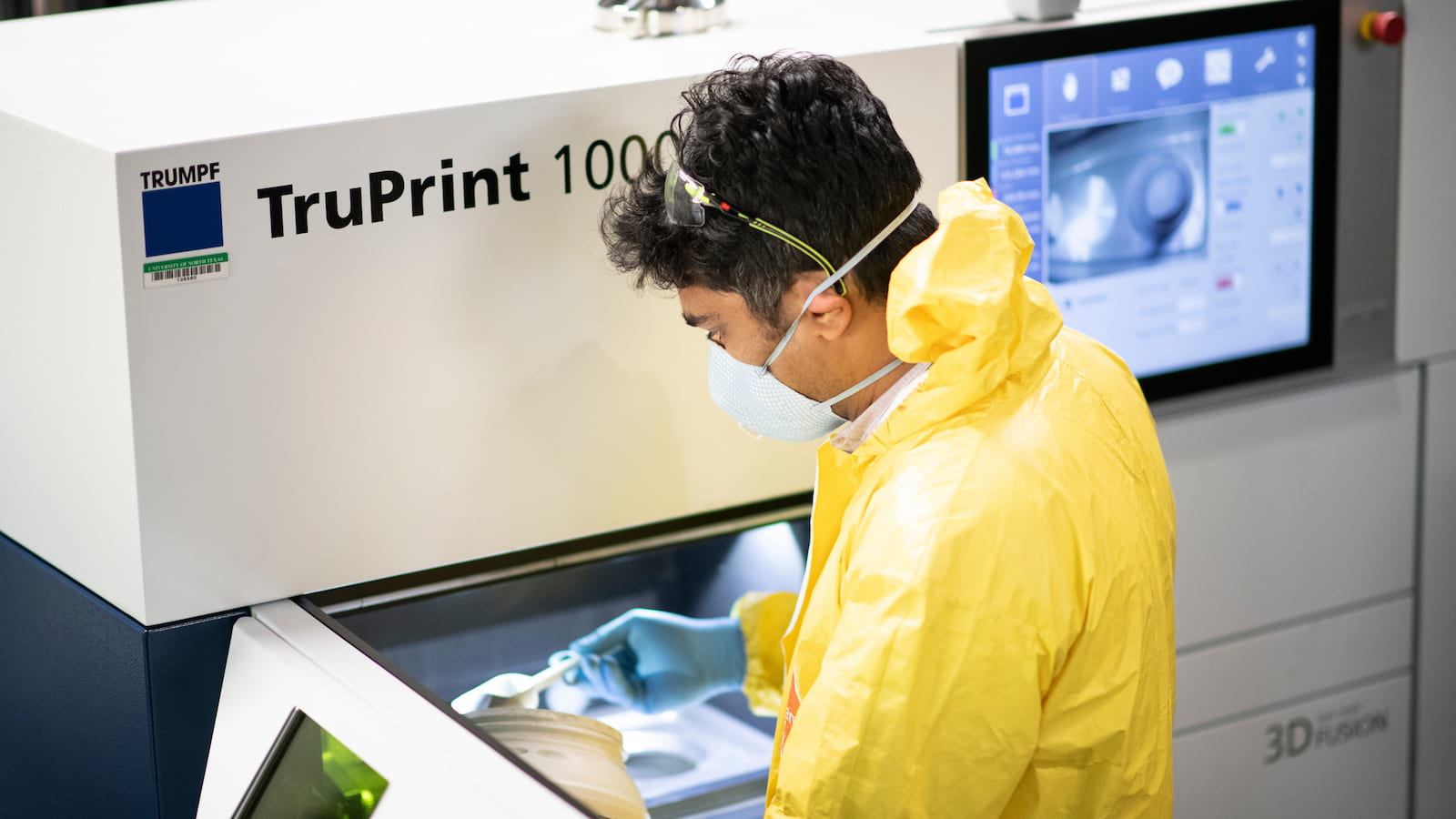
The Department of Materials Science and Engineering is committed to training students at the undergraduate and graduate levels in all aspects of modern materials, including metals, ceramics, polymers, electronic and optical materials, and materials characterization. Our high-tech facility allows students to train on cutting-edge equipment.
As a student in the Department of Materials Science and Engineering at the University of North Texas, your top-notch education will enable you to develop specialized skills through classroom instruction from accomplished faculty, research with modern equipment and facilities, and connections with industry leaders.
The department will also help you build relationships with businesses and professionals in the Dallas–Fort Worth region and with universities both locally and throughout the world. With these connections, we can help you find co-ops and internships that offer real-world training with industry leaders to build upon your classroom knowledge and prepare you for your future career.
Marketable Skills
- Identify materials engineering problems
- Produce solutions for materials selection/applications
- Material data collection and interpretation
- Conduct material conceptual design/development
- Teamwork
Materials Science and Engineering Degree Highlights
Having one of the most advanced analytical characterization facilities in the country
allows students to receive training on state-of-the-art equipment.
The department’s alumni base is strong, and many serve as mentors to undergraduate students throughout the
student’s academic career.
Our professors and researchers have expertise in metals, ceramics, polymers, electronic
materials and computational materials science, and many are internationally and nationally
known for their work.
Our computer engineering, electrical engineering, materials science and engineering,
mechanical and energy engineering degrees are accredited by the Engineering Accreditation
Commission (EAC) of ABET.
In addition to numerous research labs, including the Materials Research Facility, the department supports the Advanced Materials and Manufacturing Processes Institute (AMMPI) and the Center for Friction Stir Processing.
The department occupies approximately 25,000 square feet in UNT’s Discovery Park, with about 40,000 square feet of unfinished space in which to expand.
What Can You Do With A Degree in Materials Science and Engineering?
Students who graduate with a Bachelor of Science degree with a major in materials science and engineering can expect a very healthy job market and relatively high starting salaries in a variety of industries. Materials science and engineering graduates are heavily sought after by industries of all types, including automotive, chemical, aerospace, microelectronics, magnetic storage, transportation, sports, defense, forensics and manufacturing.
A B.S. degree with a major in materials science and engineering also prepares students for continuing their education with a master’s or a doctoral degree in materials science and engineering or in a related field.
Materials Science and Engineering Degree Courses You Could Take
Bonding and Structure (3 hrs)
Amorphous and crystalline structures in metals, ceramics and polymers, point defects
in crystals, structure determination by X-ray diffraction.
Transport Phenomena in Materials (3 hrs)
Principles of transport phenomena (momentum, heat and mass transport) in materials
processes including heat, mass and momentum transport. Emphasis on applications of
appropriate differential equations and boundary conditions to solve real materials
processing problems.
Electrical, Optical and Magnetic Properties of Materials (3 hrs)
Bonding and the electronic structure and properties of metallic, ceramic, semiconducting
and polymeric materials.
Materials Processing (3 hrs)
Basic principles and strategies for processing metals, ceramics, polymers, composites
and electronic materials.
Materials Selection and Performance (3 hrs)
Integration of structure, properties, processing and performance principles to formulate
and implement solutions to materials engineering problems.
Discover How and Why Materials “Matter” (3 hrs)
Course serves as the heart of the MSE first year experience. Topics include rationale
for materials choices, composition and design of everyday items and how materials
science and engineering drives innovation. Basic analysis and experimental design.
A team-based, hands-on project teaches the student to think critically and creatively
by applying a range of analysis techniques borrowed from many engineering and science
disciplines.
Learn More About UNT
Watch this video to learn more about what makes UNT great!